Targeting the LGBTQIA+ Community.

The Untold Costs of Civilian “Predator Catcher” Stings in Palm Beach County
A Question Worth Asking
In March 2025, a 19-year-old in Brevard County allegedly used a printed list of nearby registered sex offenders to identify a 28-year-old man, then killed and dismembered him. According to the arrest affidavit, he told his girlfriend he killed the man “because he was a sex offender.” (WFTV; Oxygen)
Now ask yourself a question. What happens when private citizens, motivated by clicks and donations, livestream a man’s face, name, and location to hundreds of thousands of viewers, brand him a predator before any court has heard a word of evidence, and leave the rest to the internet?
This article is about 561 Predator Catchers (561PC), the Palm Beach County vigilante operation behind dozens of arrests, the overwhelming majority in Delray Beach. It is about who they are, how they operate, who profits, and what their methods mean for the Constitution, for public safety, and for the rule of law. The evidence below comes from court records, police body-worn cameras, sworn deposition testimony, public-records emails between law enforcement agencies, and the published record. Read it, and decide for yourself whether this is child protection or something else entirely.
The History of 561PC: A Co-Founder Walks Away
561PC was co-founded by Dustin Lampros, a professional MMA fighter, and Ryan Montgomery, a cybersecurity specialist who has since appeared on major podcasts and now works with the Sentinel Foundation. Montgomery left the group. Why?
A Florida International University Caplin News profile of Montgomery reports that two federal agents warned the pair that “continuing to do ‘vigilante’ work would discredit the evidence” in the very cases they hoped to build, because evidence gathered this way by civilians faces fatal admissibility problems in court. (FIU Caplin News, Nov. 2024) Montgomery took the warning seriously and moved to institutional channels. Lampros did not.
Since 2023, court records reflect at least 45 felony prosecutions in Palm Beach County arising from Lampros-initiated catches, a number that continues to grow. (See Appendix A.) Pause on that. Federal agents told the co-founders this model is legally defective. One co-founder stopped. The other scaled up. And one police department, more than any other, kept answering his calls.
“Your Guys’ Cops Told Us to Post It”: The Delray Beach Relationship
Delray Beach’s official position is unambiguous. In a statement provided through Sergeant Casey Kelly of its Investigative Division, obtained through a public records request, the department declared: “We want to re-emphasize that we are in no way working with or partnering with Mr. Lampros, 561 Predator Catchers or any other vigilante group. We do not approve, condone, encourage, or promote their actions.” Sergeant Kelly added that there “was no coordinated ‘sting operation’ conducted by the Delray Beach Police Department and there never will be with any vigilante group.” (DBPD/BSO email exchange, Nov. 21, 2024, Bates 000239-000242, Exhibit B-1)
Now compare that statement to the sworn and recorded record.
In his deposition in State v. S.D., Lampros testified under oath that he never even posted videos of his first six catches until a Delray Beach officer encouraged him: “it was a Delray cop. He was like, yo, you should be exposing these guys, too.” That suggestion, he testified, is “where we created the YouTube and Instagram account.” (Lampros Depo., State v. S.D, at 35-36, Exhibit B-2) That channel is now monetized, as Lampros has acknowledged in the same deposition. (Lampros Depo., State v. S.D. Follow the sequence: the police suggest the channel, the channel gets monetized, and the catches that feed it multiply.
Delray Beach’s own body-worn cameras captured the same admission in real time. In June 2024 footage produced in State v. G.M., Lampros tells Officer Vickery on camera: “your guys cops told us to post it. We never had a channel, we never did nothing.” In the same footage, Officer Imani Jones tells Lampros, “I’m trying to help you strengthen your case,” officers instruct him on when to call and whom (“Don’t call us, call Kelly”), and Lampros recounts sitting down with Sergeant Kelly, who, he says, gave him a list of offenses the department could make arrests on: “A, B, C, D... And we’ve had every one of these since.” (DBPD BWC, Axon Body 3 X60AB113A and Axon Fleet 2 X54002341, June 16-17, 2024, Exhibit B-3)
The Palm Beach Post’s reporting matches the tapes. The Post reported in February 2025 that, by Lampros’s own account, Delray Beach detectives advised him how to conduct catches in a way that was easier to prosecute, that its officers were the first to suggest he film and upload his catches, and that officers routinely tell him the arrests “make us feel like we have a purpose for the first time.” With his help, the Post reported, the agency arrested more people on traveling-to-meet-a-minor allegations in 2024 than in the prior five years combined, and every probable cause report opens with a nod to 561 Predator Catchers. (Palm Beach Post, Feb. 6, 2025) A companion Post investigation found that of the first wave of nearly two dozen defendants, not one was caught by police; every case began with the YouTubers, their cameras, and a donation link. (Palm Beach Post)
So here is the question. When a department’s officers suggest the YouTube channel, coach the catches for easier prosecution, hand over a checklist of arrestable offenses, designate a point of contact, and respond to arrest after arrest, what legal weight should a press release denying “coordination” carry? Florida law has a name for a civilian who investigates with the encouragement, endorsement, and participation of the police. It calls him a state agent. And state agents are bound by the Constitution.
“My Goal Is to Break Them Down”: Question First, Miranda Later
When law enforcement interrogates a suspect in custody, Miranda v. Arizona requires warnings. When questioning is deliberately structured to extract an unwarned confession first and Mirandize later, Missouri v. Seibert condemns the tactic. So what should we make of a system in which the unwarned interrogation is outsourced to a civilian with a camera while uniformed officers stand by and take notes?
Lampros has described his method himself, publicly, on The Resilient Show podcast: his goal is to “break them down to where once the cops show up, they feel defeated,” so that, by his own estimate, roughly eight out of ten targets repeat everything to the police. (The Resilient Show, Lampros appearance; clip at YouTube Shorts) On the same episode he boasted that South Florida police departments are being retrained because of his work, and characterized the federally funded ICAC task force as telling its member agencies that one man on the outside was out-producing them.
That is not a vigilante stumbling into constitutional problems. That is a confession pipeline, engineered to do precisely what Seibert forbids, with the unwarned phase conveniently performed by someone who claims the Fifth Amendment does not apply to him. The Post’s reporting captured the dynamic in one line: officers do not stop Lampros from asking or the suspect from answering; they take notes. Defense attorney Gregg Lerman told the Post that if police permit this, they are allowing an end-run around Miranda that their own ethical and due-process obligations forbid.
Ask yourself: if a Delray Beach detective stood in that parking lot and did what Lampros does, would a single one of those statements survive a suppression hearing?
Who Is Being Targeted, and Why?
The Numbers
Based on publicly available court records, we compiled every Palm Beach County felony prosecution we could identify arising from a Lampros-initiated catch: 45 unique cases from January 2023 through June 2026. In roughly nine of every ten, the operation used a same-sex decoy, almost always an “underage male” persona deployed against men on dating and hookup platforms. (Appendix A; methodology note below.)
These are not children’s chatrooms. The platforms at issue are 18-and-over services whose terms of service bar minors. A decoy creates a profile that displays their age as 18 or over, then injects an underage age into the conversation and steers it. Cody Mattingly, the California-based “People v. Preds” operator who has worked dozens of catches alongside 561PC, told Fox News Digital where he hunts: “The hotspot that I’ve found has been Grindr,” though he denied targeting the gay community. (Fox News Digital, Dec. 18, 2023)
A child-protection operation that draws nine of every ten targets from adult gay platforms invites an obvious question: is that an investigative accident, or an agenda?
An Old Lie in New Packaging
There is an ugly history here. For much of the twentieth century, American law and culture promoted the false claim that gay men were inherently predisposed to molest children. It fueled the Lavender Scare purges of the 1950s and Anita Bryant’s 1977 “Save Our Children” campaign in Dade County, Florida, and it has been discredited by decades of peer-reviewed research. Psychologist Gregory Herek of UC Davis, one of the nation’s leading researchers on prejudice against sexual minorities, reviewed the empirical literature on this precise question, documented the Bryant campaign as its modern political origin, and concluded there is “no scientific basis” for asserting that gay or bisexual men are more likely than heterosexual men to molest children. (Herek, “Facts About Homosexuality and Child Molestation”) A study in Pediatrics examined 269 cases of suspected child sexual abuse and could identify the offender as gay or lesbian in only two; the overwhelming majority of offenders were heterosexual men. (Jenny, Roesler & Poyer, Are Children at Risk for Sexual Abuse by Homosexuals?, 94 Pediatrics 41 (1994)) The American Psychological Association’s position is the same: children are not at elevated risk of molestation by gay adults. A sting model that harvests roughly nine of every ten of its targets from adult gay platforms does not merely echo that discredited myth. It re-monetizes it.
Who Actually Gets Caught
The people swept up in these operations are frequently not the fixed, predatory offenders the videos advertise. Adam Scott Wandt, an attorney and assistant professor of public policy at John Jay College of Criminal Justice, has studied civilian sting operations and warns: “It’s dangerous in so many ways... The whole thing is a recipe for disaster.” Many targets, Wandt explains, have significant mental health issues, and enticing them into a state of mind that emboldens predator-type behavior can itself push vulnerable people toward conduct they would never otherwise initiate. (Bucks County Courier Times / phillyburbs.com, Apr. 26, 2022)
The clinical literature distinguishes between the narrow class of persons with a persistent sexual interest in children and the much larger population these stings net: men in their twenties and thirties, often with no prior record and no illicit images on their devices, sometimes mid-crisis, responding on an adult platform to a profile that was an adult until the script changed. The question the criminal law has always asked, and a livestream never does, is the oldest puzzle in attempt doctrine: confronted with a real 14-year-old instead of a fantasy, would this person have said no?
The Company They Keep
Cody Mattingly
The question of agenda is not hypothetical with Mattingly. In a December 15, 2021 Discord exchange from the verified “People v. Preds” account he operates, Mattingly wrote: “I hate all gay people so... the argument is valid and not worth my time.” (Exhibit B-4) Publicly indexed video clips from his own branded catches capture him shouting an anti-gay slur at a target (Exhibit B-5), and, in a separate clip in the same public index, telling viewers upset by the slur to leave, expressing no remorse. (Clip index) YouTube removed at least one Mattingly video under its harassment and cyberbullying policy, which prohibits prolonged insults or slurs based on protected-group status, a category that expressly includes sexual orientation. (Exhibit B-6)
This is the man who has stood beside Lampros on dozens of catches drawn overwhelmingly from gay platforms. When the catcher hates the community he fishes from, what exactly is being protected, and what is being hunted?
Vitaly Zdorovetskiy: The Times Holds Up a Mirror
Lampros has also operated alongside Vitaly Zdorovetskiy, the Russian-born prank YouTuber turned Kick streamer. In June 2026, New York Times reporters Kashmir Hill and Aric Toler published a granular reconstruction of what Zdorovetskiy’s “predator catching” actually is: a monetized humiliation business that ambushed an innocent man. (N.Y. Times, June 10, 2026) Their reporting deserves to be read in full. What it deserves even more is to be read side by side with the Palm Beach County record, because at nearly every point the Times documents about Zdorovetskiy’s operation, the court records, body cameras, and sworn testimony in this county document the same thing about 561PC. And this is not an analogy between two separate worlds: Zdorovetskiy stood next to Lampros at the Delray Beach movie theater catch, livestreaming on the same platform, in the same operation. (Miami Herald)
Start with the target. The Times reconstructed how Zdorovetskiy’s crew ambushed Akash Singhania, an innocent 25-year-old, in a Santa Ana park before a live audience of more than 24,000. Singhania had matched with the decoy on an adult hookup app; the claim that she had disclosed being 16 arrived, if at all, on a different platform, in messages Singhania insisted were not his. Now look at Appendix A: roughly nine of every ten Lampros catches likewise began on adult platforms, with the underage script injected into a space whose every user has attested to being 18.
Next, the method of confrontation. The Times describes a crew that surrounded Singhania, shouted, talked over one another, and showed no interest in reviewing the exculpatory messages he was holding up on his phone. Lampros has described the identical method in his own words, on a podcast: the goal is to “break them down to where once the cops show up, they feel defeated.” (The Resilient Show) The Times’s subjects perform outrage for the camera. So, by his own account, does ours.
Then, the police. The Times reports that when Santa Ana officers arrived, one recognized Zdorovetskiy and shook his hand, and before driving away with the innocent man handcuffed in the back seat, the officers asked the famous prankster for a photo. In Delray Beach, the body cameras go further: officers seeming to coach Lampros on procedure, telling him whom to call and when, and a sergeant, per Lampros’s account, supplying the list of offenses the department could arrest on. (DBPD BWC, Montero, Exhibit B-3) Santa Ana gave Vitaly a handshake. Delray Beach gave Lampros a workflow.
Then, the economics. The Times reports that decoys in Zdorovetskiy’s operation are paid bounties of a few hundred dollars per target who shows up, that his streams are sponsored by a casino-backed platform, and that a paid network of “clippers” seeds the humiliation across social media for per-view payouts. The Palm Beach County analog is in the record: a YouTube channel created at the suggestion of Delray Beach officers, now monetized. (Lampros Depo., S.D.)
Then, the mob. The Times documents the livestream chat doxxing Singhania in real time, finding his Facebook, his company, his father’s name and business, and calling for him to be deported and killed; the harassing calls reached his family within hours, and strangers were still recognizing him in airports months later. That is the machine every 561PC target is fed into, before arraignment, before discovery, before a jury hears a word.
And finally, the verdict on the whole enterprise, delivered by its own star. As police drove an innocent man away in handcuffs, Zdorovetskiy turned to his camera and pronounced it: “Perfect guy, perfect clip.”
The Times traces this genre to its ancestor, NBC’s “To Catch a Predator,” which ended after a Texas prosecutor died by suicide while a camera crew waited outside his home. The lawsuit that followed produced a judicial warning that should be required reading in every police department now fielding calls from a predator catcher. Denying NBC’s motion to dismiss, Judge Denny Chin wrote that on the facts alleged, “a reasonable jury could find that NBC crossed the line from responsible journalism to irresponsible and reckless intrusion into law enforcement.” Conradt v. NBC Universal, Inc., 536 F. Supp. 2d 380 (S.D.N.Y. 2008). That was a national network, with lawyers, standards departments, and a journalism pedigree, working alongside police. If that crossed the line, ask yourself where an MMA fighter with a Kick stream, a donation link, and a sergeant’s checklist stands.
Zdorovetskiy has separately been sued by screenwriter C. Jay Cox over a 2024 catch in which Cox alleges the decoy lied about age. (Sportskeeda) Lampros himself has since publicly distanced his operation from Zdorovetskiy, in a video posted to his own YouTube channel. But distance is not a defense. The Singhania ambush was not a malfunction of the model Lampros shares with Zdorovetskiy. It was the model, working exactly as designed, on the wrong man.
When even the predator catchers admit they sometimes catch the innocent, what is the error rate of a system with no warrants, no supervision, no discovery, and no judge? And when the innocent man’s exoneration arrives only after the clips have circled the globe, what remedy is left?
The Rule Police Departments Are Ignoring
The Department of Justice’s ICAC Operational and Investigative Standards, which bind every task force and affiliate agency that accepts ICAC funding, are blunt: members “shall not collaborate with Vigilantes,” and shall not condone, encourage, or promote vigilante activities; only law enforcement personnel may direct investigations. (ICAC Operational and Investigative Standards)
The commander of the South Florida ICAC Task Force saw the problem and said so, in writing. On November 21, 2024, Sergeant Thomas McInerney of the Broward Sheriff’s Office, the South Florida ICAC Task Force Commander, emailed Delray Beach’s Sergeant Kelly after yet another round of 561PC arrests made the news. McInerney pressed the department on its prior assurances and wrote that his concern was that Lampros “seems to continue his vigilantism activities only in the City of Delray as you are the only agency that I am aware of now that makes an arrest on scene when he calls after his extremely unsafe encounters.” He noted that the media, and Lampros himself, continue to publicly state that he works in conjunction with the department, in opposition to everything the agency advises, and he offered to discuss ways to discourage what he called Lampros’s dangerous activities. (BSO/DBPD emails, Nov. 21, 2024, Bates 000239-000242, obtained by public records request, Exhibit B-1)
Delray Beach’s response was the disavowal quoted above, paired with an assurance that the department remains “committed to upholding the ICAC Operational and Investigative Standards.”
Hold the two records side by side. The federal standards prohibit collaboration with vigilantes. The regional ICAC commander identified Delray Beach, in writing, as the one agency whose on-scene arrests keep this vigilante in business. The department’s own body cameras show its officers coaching him, and its own sergeant supplying his checklist. So answer the question the standards force: what do you call that, if not collaboration?
Public Safety: The Movie Theater That Almost Wasn’t a Story
Consider the catch 561PC ran at a movie theater on NE Fourth Avenue in Delray Beach in February 2026. The target was C.D., a 50-year-old Miami-Dade Sheriff’s Office lieutenant who, per the arrest report, came to meet someone he believed was a 15-year-old. Lampros and Zdorovetskiy confronted him as the group livestreamed on Kick; Delray Beach police responded, and the Miami-Dade sheriff immediately moved to fire him. (Miami Herald) And C.D. came armed. According to the arrest report, a Delray Beach sergeant who detained him took a handgun from his waistline. (NBC6; CBS12)
Now add the variables. An armed, sworn law-enforcement officer, confronted by surprise. A confrontation crew led by a professional fighter who has acknowledged, in the same podcast appearance quoted above, that he himself comes to these confrontations armed. (The Resilient Show) A crowded theater on a Friday night. A live audience on Kick. No tactical plan, no supervisor, no use-of-force policy, no background on whether the target is armed, violent, or suicidal; here, he was armed, and nobody on the catch crew knew it until a police sergeant pulled the gun off his waist. The ICAC commander’s phrase from the public records, “extremely unsafe encounters,” was not rhetoric. It was a professional threat assessment. What happens the night one of these men panics?
And the danger does not end when the stream does. The man on camera is broadcast to an audience that, as the Times documented in the Singhania ambush, treats the chat box as a colosseum, doxxing targets in real time and calling for them to be killed.
The Aftermath Nobody Streams
The livestream ends. The consequences do not.
Many of those caught are in their early twenties and thirties and would not be clinically classified as predisposed offenders. Yet a conviction can carry lifetime sex-offender registration in Florida, with residency-distance requirements from schools, parks, and daycares that make lawful housing scarce, effectively excluding most HOA communities and any landlord who runs a background check. Employment prospects collapse. The stigma is permanent. All of this attaches to men the State never alleges touched a child, in cases where the dispositive question, whether the defendant would truly have gone through with it, is rarely tested, because the videos make trials feel impossible: most plead.
Meanwhile, the livestream itself is a punishment that precedes any verdict. The accused’s face, name, and whereabouts circulate to an audience of hundreds of thousands. Death threats follow. And as Brevard County demonstrated, there are people willing to act on a list of names: a teenager allegedly hunted down, killed, and dismembered a 28-year-old precisely because a registry told him where to look. (WFTV)
If a registry entry alone can get a man killed, what does a viral video with his face, his confession-by-ambush, and his location do?
Conclusion: The Rule of Law, or the Rule of Views
None of this is a defense of adults who seek out children. It is a defense of something older and larger: the proposition that guilt is determined by courts, not by Kick chat; that interrogations are governed by Miranda, not monetization; and that a police department does not get to launder constitutional shortcuts through a civilian with a camera crew and then disclaim him in a press release its own body cameras contradict.
The co-founder of 561PC heard federal agents say this model poisons its own cases, and he walked away. The Department of Justice’s standards forbid funded task forces from collaborating with vigilantes, and the regional ICAC commander put his concerns about Delray Beach in writing. The department’s officers suggested the YouTube channel, coached the catches, and supplied the checklist, all while the department publicly declared it does not “approve, condone, encourage, or promote” any of it.
So the final question is the one this entire enterprise is built to avoid: in Palm Beach County, does the rule of law still outrank the rule of views?
Alan Bernstein is a criminal defense attorney with more than 35 years of experience practicing in Palm Beach and Broward counties.
Appendix A: Lampros-Initiated Prosecutions, Palm Beach County (Jan. 2023 – June 2026)
Methodology: Compiled from publicly available Palm Beach County court records. “Same-sex decoy” reflects the decoy persona documented in the charging records (an “underage male” persona deployed against a male defendant, or “underage female” against a female defendant). Defendant surnames are redacted, and duplicate filing entries have been consolidated. Of 45 unique prosecutions identified, 40 (approximately 89 percent) involved a same-sex decoy.
# | Defendant | Arresting Agency | Decoy Persona | Arrest Date | Same-Sex Decoy |
1 | Bryan S. | Delray Beach PD | Underage Female | 1/21/2023 | No |
2 | Travis Scott M. | Palm Beach Sheriff’s Office | Underage Male | 2/8/2024 | Yes |
3 | Thomas O. | Palm Beach Sheriff’s Office | Underage Male | 4/19/2024 | Yes |
4 | Ronald Thomas K. | Palm Beach Sheriff’s Office | Underage Male | 4/25/2024 | Yes |
5 | Nicholas W. | Delray Beach PD | Underage Male | 6/11/2024 | Yes |
6 | Eric Geoffrey M. | Jupiter PD | Underage Male | 6/12/2024 | Yes |
7 | Carlos A. | Boca Raton PD | Underage Male | 6/21/2024 | Yes |
8 | Emmanuel M. | Delray Beach PD | Underage Male | 6/28/2024 | Yes |
9 | Valerie S. | Delray Beach PD | Underage Female | 7/7/2024 | Yes |
10 | Michael W. | Delray Beach PD | Underage Male | 7/7/2024 | Yes |
11 | Gabriel Andres M. | Delray Beach PD | Underage Male | 7/9/2024 | Yes |
12 | Christopher Michael B. | Delray Beach PD | Underage Male | 7/11/2024 | Yes |
13 | Joshua F. | Delray Beach PD | Underage Female | 7/17/2024 | No |
14 | Oscar Decastro A. | Delray Beach PD | Underage Male | 7/19/2024 | Yes |
15 | Joel G. | Delray Beach PD | Underage Male | 7/21/2024 | Yes |
16 | Joshua H. | Delray Beach PD | Underage Male | 7/24/2024 | Yes |
17 | Michael T. | Delray Beach PD, PBSO | Underage Female | 8/7/2024 | No |
18 | Joseph M. M., Jr. | Delray Beach PD | Underage Male | 9/11/2024 | Yes |
19 | Henry Robert J. R. | Delray Beach PD | Underage Male | 10/12/2024 | Yes |
20 | Artemie M. | Delray Beach PD | Underage Male | 10/30/2024 | Yes |
21 | Brett P. | Delray Beach PD | Underage Male | 11/1/2024 | Yes |
22 | Daniel W. | Delray Beach PD | Underage Male | 11/4/2024 | Yes |
23 | Mahesh Venkatasi K. | Delray Beach PD | Underage Male | 11/5/2024 | Yes |
24 | Francois L. | Delray Beach PD | Underage Male | 11/8/2024 | Yes |
25 | Samuel D. | Delray Beach PD | Underage Male | 11/10/2024 | Yes |
26 | Alan B. | Delray Beach PD | Underage Male | 12/12/2024 | Yes |
27 | Joel Devere A. | Delray Beach PD, PBSO | Underage Male | 1/22/2025 | Yes |
28 | Jeffrey Neil S. | Delray Beach PD, PBSO | Underage Male | 2/5/2025 | Yes |
29 | Matthew D. | Palm Beach Sheriff’s Office | Underage Male | 5/1/2025 | Yes |
30 | Stephon E. M. | Delray Beach PD | Underage Male | 5/6/2025 | Yes |
31 | Fedler D. | Delray Beach PD | Underage Male | 5/6/2025 | Yes |
32 | Samuel S. | Delray Beach PD, PBSO | Underage Male | 5/7/2025 | Yes |
33 | Louis Mark B. | Delray Beach PD | Underage Male | 5/13/2025 | Yes |
34 | Nicholas M. P. | Boynton Beach PD | Underage Male | 8/14/2025 | Yes |
35 | Adam W. | Boynton Beach PD | Underage Male | 8/15/2025 | Yes |
36 | Brian Matthew C. | Delray Beach PD | Underage Male | 9/1/2025 | Yes |
37 | Levi C. | Delray Beach PD | Underage Male | 9/19/2025 | Yes |
38 | Robin Zechariah H. | Boynton Beach PD | Underage Male | 10/9/2025 | Yes |
39 | Alfredo B. | Delray Beach PD | Underage Male | 12/11/2025 | Yes |
40 | Gabriel C. | Delray Beach PD | Underage Male | 2/13/2026 | Yes |
41 | Christopher D. | Delray Beach PD | Underage Female | 2/27/2026 | No |
42 | Benjamin Edward P. | Delray Beach PD | Underage Male | 3/2/2026 | Yes |
43 | Christopher Lee A. | Delray Beach PD | Underage Female | 5/9/2026 | No |
44 | Christian W. | Delray Beach PD | Underage Male | 5/26/2026 | Yes |
45 | Franco V. | Delray Beach PD | Underage Male | 6/6/2026 | Yes |
Summary statistics: 45 unique prosecutions; 40 of 45 (88.9%) same-sex decoy; 36 of 45 (80%) list Delray Beach PD as an arresting agency (alone or jointly); remaining agencies: Palm Beach Sheriff’s Office (4 solo, 5 joint), Boynton Beach PD (3), Jupiter PD (1), Boca Raton PD (1).
Appendix B: Exhibits
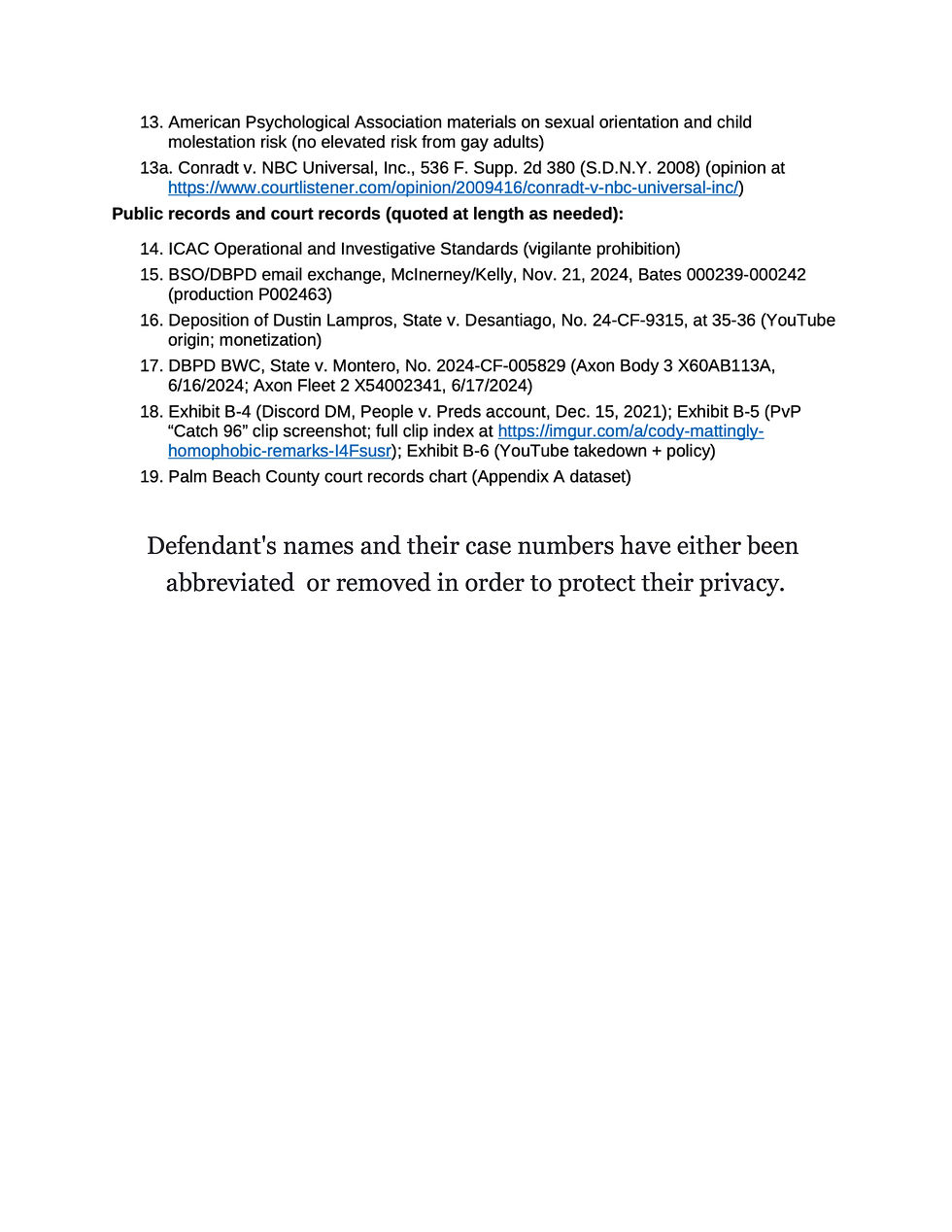
Each exhibit referenced in this article is a public record, a court record, or evidentiary material compiled by the author, reproduced in full in the document edition of this article. Copyrighted press materials cited (the New York Times report, the Palm Beach Post articles, the Fox News Digital article, and The Resilient Show episode) are quoted briefly above under fair use and linked in the text.
Exhibit B-1: BSO/DBPD public-records emails, Bates 000239-000242 — the November 21, 2024 exchange between Sergeant Thomas McInerney, South Florida ICAC Task Force Commander (Broward Sheriff’s Office), and Sergeant Casey Kelly, Investigative Division, Delray Beach Police Department, subject “561 Catch a Predator.” Obtained by public records request (production P002463).
Exhibit B-2: Lampros deposition excerpts, State v. S.D., at 35-36.
Exhibit B-3: Delray Beach PD body-worn camera footage produced in State v. G.M., (Axon Body 3 X60AB113A and Axon Fleet 2 X54002341, June 16-17, 2024).
Exhibit B-4: December 15, 2021 Discord exchange from the verified “People v. Preds” account.
Exhibit B-5: Publicly indexed video clips of Mattingly-branded catches.
Exhibit B-6: YouTube removal under its harassment and cyberbullying policy.




Comments